

Why this matters to visitors
A neighbourhood's reputation in a guidebook can lag reality by five to ten years in a fast-moving city. What was a "gritty, authentic" area in a travel magazine from 2018 may now be full of $22 cocktail bars; what sounds "up and coming" might be mid-transformation in ways that affect how you experience it. This page tracks the current situation honestly.
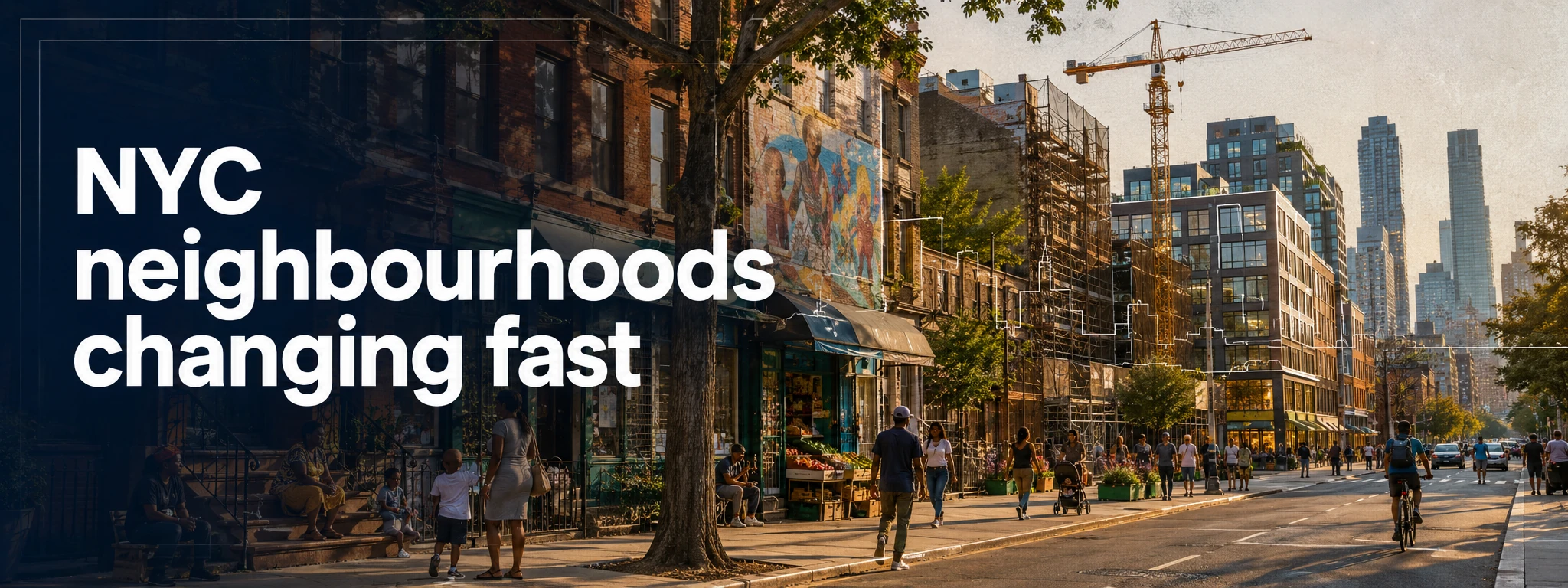
Where the most visible change is happening
Crown Heights and Flatbush (Brooklyn) — significant new residential construction and incoming businesses in areas that were stable working-class and Caribbean community neighbourhoods for decades. The cultural character remains but is visibly under pressure.
Ridgewood (Queens/Brooklyn border) — spilling over from Bushwick, increasingly well-reviewed restaurants and bars in what was a very quiet residential neighbourhood. Earlier in the curve than Bushwick was five years ago.
Mott Haven (South Bronx) — new waterfront development and a deliberately cultivated art-gallery scene near the East River, in a neighbourhood with real poverty and complex history. The contrast is stark and intentional.
Long Island City (Queens) — post-Amazon-HQ2-cancellation, the residential tower building continued anyway; now a genuinely dense new neighbourhood where almost nothing existed fifteen years ago.
The counterpoint
Every neighbourhood that "changes" loses something, and that something is usually people who can no longer afford to live there. This is not an abstract concern in New York — it affects millions of residents and is a constant source of real political tension in the city. An honest visit includes being aware that "discovery" tourism contributes to the same pressures.
Neighbourhoods that have changed most recently
Bushwick was probably the fastest-changing neighbourhood in the city through the 2010s, with rents rising sharply as artists displaced from Williamsburg by that neighbourhood's own price increases established studios and then attracted bars, galleries, and eventually mainstream attention. Crown Heights, Bed-Stuy, and East New York in Brooklyn followed similar but slightly later trajectories, with the pace of change in East New York still ongoing as of the mid-2020s. In the Bronx, Mott Haven and Port Morris (sometimes collectively called the South Bronx arts district) have seen significant new development and gallery presence, though at lower intensity than the Brooklyn examples.
What this means for guidebook advice
Restaurant recommendations that were accurate five years ago may refer to places that have closed, significantly changed in quality, or been replaced by something better or worse. Neighbourhood character descriptions lag even faster than business listings. The practical implication for visitors is to treat any guidebook's neighbourhood recommendations (including this one) as directionally useful rather than definitively accurate, and to check current local sources — food publications, neighbourhood Instagram accounts, recent travel pieces — for specifics before arriving.
The displacement dimension
Neighbourhood change in New York is not a neutral process — it involves displacement of existing residents, often lower-income and communities of colour, who built the cultural character that made the neighbourhood attractive in the first place. Visiting a "up and coming" neighbourhood with some awareness of this history doesn't require guilt or a particular political position, but it does make for a more honest engagement with the city than treating gentrification as simply a list of new restaurants to visit.